Before we choose a sofa style or a paint colour, before we discuss budget or brand preferences, every Intero project begins with a deeper conversation. We ask our clients to consider five fundamental elements that will determine whether their home feels truly designed — or merely decorated.
These are the five elements that separate spaces that are beautiful in photographs from spaces that are beautiful to live in. They are not glamorous. They do not appear in furniture catalogues. But without them, even the most expensive furnishings will fail to create a home that truly works.
"Good design is not what you add to a room. It is the invisible framework that makes everything you add work perfectly."
1. Spatial Flow — How the Room Breathes and Moves
The most overlooked element in any home design is spatial flow — the way people move through a room, and the way the room feels as a result. A room where the furniture placement creates natural, unobstructed paths feels immediately calming. A room where you navigate around a coffee table or squeeze past a sofa to reach the TV unit creates a constant low-level stress that most homeowners attribute to clutter, but is actually a flow problem.
For every room we design, we map the primary movement paths first. The placement of every piece of furniture must be consistent with these paths — creating clear channels of movement while also defining distinct zones within the room for different activities.
Key principles:
- Main pathways should be at least 90cm wide
- Seating areas should have clear, unobstructed entry and exit points
- No piece of furniture should block a doorway, window, or the natural light path
2. Light — Natural and Artificial, Mapped Together
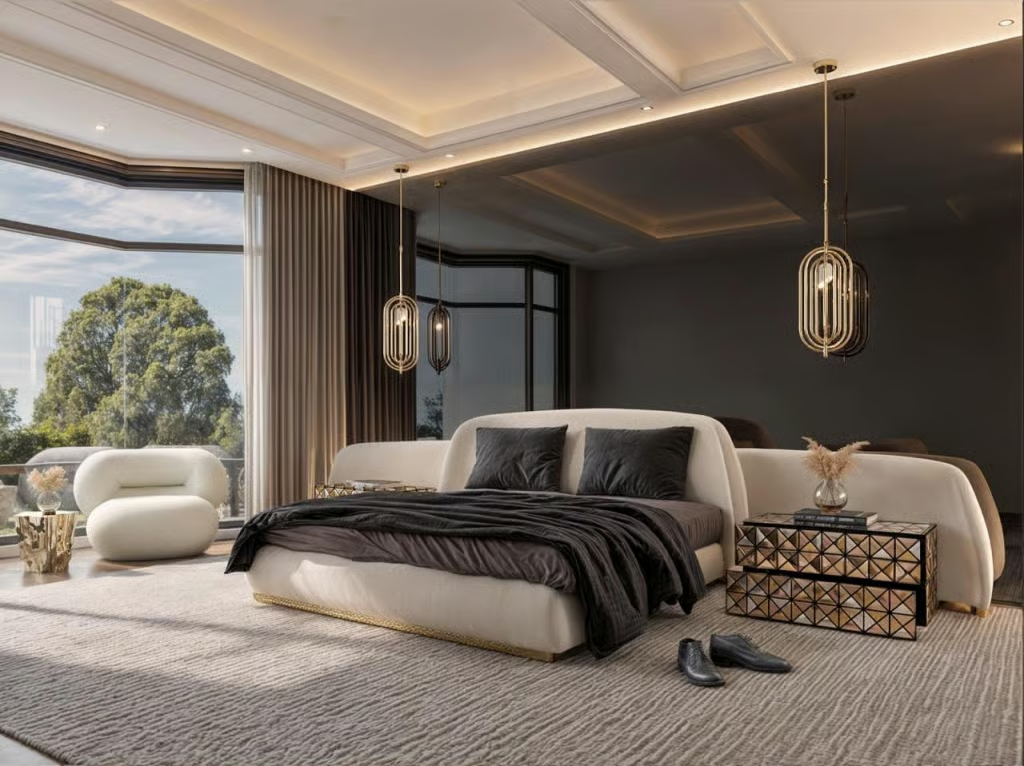
Light is not a finish or a fitting — it is the medium through which every other design decision is experienced. The most beautiful stone floor looks dull in poor light. The most carefully chosen paint colour looks wrong under the wrong bulb temperature. The most elegant sofa becomes invisible in a dark corner.
Before specifying any light fitting, Intero maps the natural light in every room: how it enters, at what time, at what angle, and how it changes through the seasons. This light map becomes the basis for the artificial lighting scheme — ensuring that the two systems work together harmoniously rather than fighting each other.
3. Proportion — Scale Relative to Space
The single most common design mistake in Indian homes is proportion errors — furniture that is too large or too small for the space it occupies. An oversized sofa in a modest-sized drawing room makes the room feel small and oppressive. A petite dining table in a large dining room looks lost and uncertain.
The rules we follow:
- A sofa should occupy no more than two-thirds of the wall it is placed against
- A coffee table should be approximately two-thirds the length of the sofa
- A dining table should allow 90cm clearance on all sides
- Artwork should be sized to the wall — a small print on a large empty wall looks timid and unresolved
4. Material Palette — Texture, Temperature, and Hierarchy
Every room has a material palette — the sum of all the surfaces and textures within it. In a well-designed room, this palette is curated and coherent. There is a clear hierarchy: a dominant material (perhaps the floor or the wall), a secondary material (the main upholstery), and accent materials (metals, cushion fabrics, decorative objects).
In Indian homes, the most successful material palettes share one characteristic: warmth. Warm woods, warm stones, warm metals, and warm textiles create rooms that feel welcoming and human. Cool palettes — white walls, grey floors, chrome fittings, glass tables — can feel beautiful in photographs but often feel cold and uninviting to live in.
"Warm materials create warm rooms. Warm rooms create warm memories. That is the quiet mathematics of interior design."
5. A Single Story — The Design Narrative
Perhaps the most important of all five elements, and the most difficult to articulate, is narrative coherence — the feeling that a room has been designed with a clear point of view rather than assembled from unrelated pieces.
Every great room tells a story. It might be a story of Indian craft heritage expressed in modern forms. It might be a story of minimalist precision. It might be a story of eclectic worldliness. Whatever the story, it should be singular and clear — evident in every choice from the floor to the ceiling.
When a room lacks this narrative — when each piece was purchased separately with no connecting thread — the result feels unsettled, regardless of how expensive or individually beautiful each piece may be. When it has this narrative, even modest pieces feel intentional and considered.